

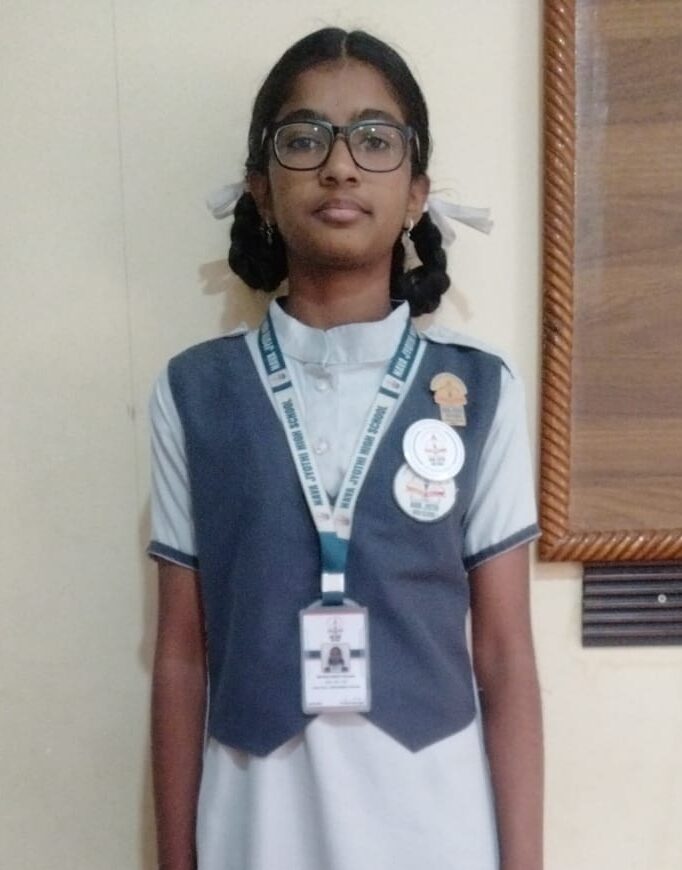
Out of 14 projects submitted, K. Netrika Reddy of Class 7 had her project selected. We are sharing her original handwritten submission as it is. It may contain spelling or grammatical errors. We kindly request readers to consider her age and maturity, and not to judge her work harshly — She has miles to go and a bright journey ahead.
Project Submitted By : K. Netrika Reddy of Class 7C
Child Labour
“Even in the modern world, many children are forced to work instead of going to school. Why does child labour still exist, and what does it cost children, families, and society in the long run?”
Investigate:
- The root causes of child labour, such as poverty, lack of access to education, social inequality, and weak enforcement of laws.
- How child labour affects a child’s physical health, mental well-being, education, and future opportunities
- The long-term impact on society, including cycles of poverty and reduced national development
Then, move towards solutions:
What responsibilities do governments, communities, schools, industries, and individuals have in preventing childlabour?
What practical steps can be taken to protect children’s rights, ensure quality education, and support families so thatchildren are not forced to work?
Support your views with examples, laws, case studies, or real-life observations wherever possible.
Initial Understanding:- Child labour refers to the employment of children in any work that deprives them of their childhood, interferes with education and is harmful to their physical, mental, or emotional well-being . It involves exploiting children for labor, often in hazardous conditions, and denying them their basic rights and dignity .
- Exploitation: Children are often paid none at all or low wages .
- Hazardous work: Children engaged in work that risks their health, safety, or morals
- Denial of education: Child labour takes children away from school and opportunities .
- Vulnerability: Children in poverty are often trapped in cycles of child exploitation .
Child labour is when kids are made to work, often in tough conditions, instead of going to school or playing. It can be harmful to their health, happiness and furture. Think of kids working long hours, getting low pay and missing out on education.
Why does it happen?
- Kids work instead of studying because of their parents.
- Poverty and financial struggles.
- Lack of access to quality education.
- Weak laws and enforcement.
- Cultural or societal norms.
Simple breakdown:-
- Often in tough or unsafe conditions.
- Can hurt their health and furture.
- Affects their childhood rights.
Later Understanding:-
The burden or blight of poverty fall most heavily upon the child. No more responsible for its poverty than for its birth, the helplessness and innocene of the victims. Infinite horror to its suffering, for the centuries have not made tolerable. The idea that the weakness or wrongdoing of its parents or others should be expiated by the suffering of the child labour. The poverty of civilized man, which is everywhere coexistent with unbounded wealth and luxury. The child poverty is terribly handicapped at very start.
Biologically, the first year of life are supremely important. They are the foundation years, and just as the stability of a building must depend largely upon the skill and care with which its foundations are laid. The character and life of a child is depend upon the circumastanceses around him or her. For millions of children the whole of life is conditioned by the first years.
However, the occasional hunger, the loss of a few meals now and then in such periods of distress, that is of most importance, it is the chronic underfeeding day after day, month after month, year after year. Even where lack of all food is rarely or never experienced, there is often chronic underfeeding. Poverty and death are grim camponions.
Laws to eradicate child labour:-
- Prohibition and Regulations Act, 1986:– Prohibits child labour in hazardous occupations.
- Rights to Education Act, 2009:- Ensure free education for children aged 6-14.
- National Child Labour Project (NCLP):- Rescues and rehabilitates child labourers.
- Pencil Project:– Aims to mainstreams child labourers into formal education.
Suprising things:-
- Hidden workers:- Child labour is often invisible, with many children working informal sectors like agriculture, domestic work or small workshops.
- Not just poverty:- Child labour exists even in relatively well-off families due to factors like lack of awareness or education.
- Girls are more vulnerable:- Girls are more likely to be engaged in child labour, often domestic work or unpaid family labour.
- Urban areas are hubs:- Many child labourers work in urban areas, often in hazardous condition.
- Bonded labour:- Some children are forced into labour to repay family debts, a form of modern day slavery.
- Not just India:- Child labour is a global issue, with countries like Pakistan, Bangladesh and Nigeria also struggling.
- Education is key:- Lack of access to quality education is a major driver of child labour.
Suggestions:-
- Implement stricter laws and penalties for child labour.
- Ensure access to quality education for all children.
- Launch nation wide awareness drives on child labour’s impact.
- Provide financial aid and resources to poor families.
- Offer skill development programes for older children.
- Involve local communities in preventing child labour.
- Encourage companies to adopt child labour free policies.
- Collabarate with organizations working on child labour.
- Provide nutritious meals in schools to attract kids.
- Educate parents about the importance of education.
- Track and monitor child labour cases effectively.
Conclusion:-
Child labour still exists in India despite several laws and government initiatives aimed at protecting children. Many children are still forced to work in factories, farms, small shops, and homes because of poverty, lack of access to education, and social inequality. While laws such as the Child Labour (Prohibition and Regulation) Act, 1986 and the Right of Children to Free and Compulsory Education Act, 2009 have helped reduce child labour, the problem has not been completely eradicated.
To fully eliminate child labour, stronger enforcement of laws, improved quality of education, financial support for poor families, and greater public awareness are essential. Governments, organizations, communities and individuals must work together to protect children’s rights and ensure that every child spends their livelihood on learning, graving and dreaming rather than working. Only through collective effort can India build a furture where every child is free from labour and has the opportunity to live with dignity and hope.


Leave a Reply